
Warren Buffett's Successor, Greg Abel, Started His Tenure With a Bang by Dumping Amazon and More Than Tripling Berkshire's Stake in a Virtual Monopoly
Key Points
Warren Buffett retired as Berkshire Hathaway's CEO on Dec. 31, and Greg Abel has wasted no time making his presence felt.
Abel completely exited 16 of Berkshire's positions in the first quarter, including Amazon -- and profit-taking likely doesn't tell the full story.
Meanwhile, Abel made a pivotal artificial intelligence (AI) stock a top-five holding.
- 10 stocks we like better than Alphabet ›
The trillion-dollar company that Warren Buffett helped build, Berkshire Hathaway (NYSE: BRKA)(NYSE: BRKB), entered uncharted territory in 2026. With the Oracle of Omaha retiring from the CEO role on Dec. 31, Berkshire has a new boss for the first time in well over half a century.
Buffett's successor, Greg Abel, hasn't wasted any time making his presence felt. During the first quarter, Abel exited 16 positions, including e-commerce kingpin, Amazon (NASDAQ: AMZN). At the same time, he more than tripled his company's stake in Google parent Alphabet (NASDAQ: GOOGL)(NASDAQ: GOOG), which has surged more than 15,500% since its initial public offering.
Will AI create the world's first trillionaire? Our team just released a report on the one little-known company, called an "Indispensable Monopoly" providing the critical technology Nvidia and Intel both need. Continue »
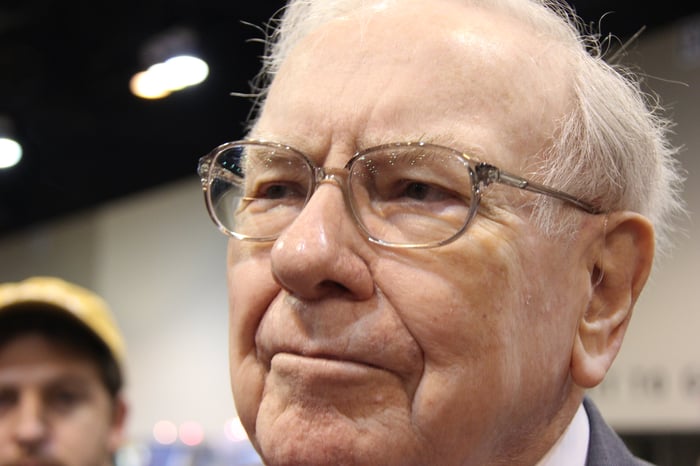
Warren Buffett retired as Berkshire Hathaway's CEO on Dec. 31, 2025. Image source: The Motley Fool.
Amazon gets the heave-ho (and profit-taking is probably only part of the story)
One of the more eye-popping first-quarter moves, as shown in Berkshire Hathaway's Form 13F, was Abel green-lighting the sale of all 2,276,000 shares of Amazon.
The argument can be made that this move was telegraphed. Buffett, in his final quarter as CEO, dumped 77% of Berkshire's stake in Amazon. Sales of that size almost always mean a holding is being given the heave-ho.
The most logical reason for Abel to send Amazon packing is to lock in sizable profits. Berkshire first acquired shares of Amazon in the first quarter of 2019. On a split-adjusted basis, Amazon stock rallied from roughly $80 to north of $200 over the last seven years.
But profit-taking probably isn't the full story.
Although Amazon's cloud infrastructure services platform, Amazon Web Services (AWS), is growing like a weed, and its online marketplace is as dominant as ever, Berkshire's new boss is a stickler for value. Amid a historically expensive stock market, Amazon's price-to-earnings (P/E) ratio of 32 stands out for all the wrong reasons.
Abel's willingness to sell a third of Berkshire's positions in the first quarter indicates his focus on value and his desire to concentrate his company's assets in his best ideas.

Image source: Getty Images.
Abel more than tripled Berkshire Hathaway's stake in Alphabet
At the other end of the spectrum, Warren Buffett's successor made Alphabet a top-five holding. Berkshire's 13F shows 36,403,656 Class A shares (GOOGL) were bought, and a new position was opened by purchasing 3,585,215 Class C shares (GOOG).
Abel, like the Oracle of Omaha, has always favored businesses with sustainable moats. Alphabet has a virtual monopoly on internet search through Google. According to GlobalStats, Google has accounted for 89% to 93% of global internet search traffic over the trailing decade.
In addition to controlling the most-visited site (Google), Alphabet is also the parent of streaming platform YouTube, the second-most-visited social site. Suffice it to say, it enjoys exceptional ad-pricing power.
This is so crazy it literally looks fake. pic.twitter.com/7GRVgy6BRs
-- Joseph Carlson (@joecarlsonshow) April 29, 2026
Alphabet's cloud infrastructure services platform, Google Cloud, is growing even faster than AWS. Integrating generative AI and large language model capabilities into Google Cloud lifted sales by 63% in the first quarter compared to the previous year. Alphabet is transforming into a cash cow and a pivotal AI player before our eyes.
But most of all, Alphabet has traditionally offered investors an intriguing value proposition. While Amazon remains historically inexpensive relative to its future cash flow, it's not a bargain based on the time-tested P/E ratio. Though Alphabet isn't exactly a screaming bargain as of this writing in late May, its shares were trading at just 17 times forward-year earnings a year ago.
Should you buy stock in Alphabet right now?
Before you buy stock in Alphabet, consider this:
The Motley Fool Stock Advisor analyst team just identified what they believe are the 10 best stocks for investors to buy now… and Alphabet wasn’t one of them. The 10 stocks that made the cut could produce monster returns in the coming years.
Consider when Netflix made this list on December 17, 2004... if you invested $1,000 at the time of our recommendation, you’d have $463,900!* Or when Nvidia made this list on April 15, 2005... if you invested $1,000 at the time of our recommendation, you’d have $1,294,401!*
Now, it’s worth noting Stock Advisor’s total average return is 978% — a market-crushing outperformance compared to 211% for the S&P 500. Don't miss the latest top 10 list, available with Stock Advisor, and join an investing community built by individual investors for individual investors.
*Stock Advisor returns as of June 1, 2026.
Sean Williams has positions in Alphabet and Amazon. The Motley Fool has positions in and recommends Alphabet, Amazon, and Berkshire Hathaway. The Motley Fool has a disclosure policy.
