
Key Points
The Vanguard Mega Cap Growth ETF (MGK) has underperformed the Invesco QQQ Trust ETF for the past 10 years.
MGK is less diversified than QQQ.
While the Vanguard fund charges a lower expense ratio, this isn’t enough to compensate for underperformance.
- 10 stocks we like better than Invesco QQQ Trust ›
Investing in U.S. tech stocks has long been one of the best moves to make with your money. But which tech exchange-traded fund (ETF) is the best fit for your goals if you want to invest in a bunch of tech companies all at once?
Many investors like the Invesco QQQ Trust (NASDAQ: QQQ), which tracks the performance of the tech-heavy Nasdaq-100 index. Buying shares of this fund -- which some call the Qs -- is a simple way to invest in tech industry leaders. For the past 10 years through March 31, this fund had delivered average annual returns (by net asset value) of 18.98 %.
Will AI create the world's first trillionaire? Our team just released a report on the one little-known company, called an "Indispensable Monopoly" providing the critical technology Nvidia and Intel both need. Continue »
An alternative is the Vanguard Mega Cap Growth ETF (NYSEMKT: MGK). This ETF owns 59 holdings with a big emphasis on tech stocks. For the past 10 years, as of March 31, it had delivered average annual returns (by net asset value) of 16.95%. Both funds have a solid track record of outperforming the S&P 500 index.
Let's look at which of these two tech ETFs could be the better buy.

Image source: Getty Images.
MGK: Lower fees; lagging performance
Many Vanguard ETFs are broadly diversified, low-cost funds that track an index. This one is more concentrated. The Vanguard Mega Cap Growth ETF has 59 holdings, and 68% of the fund consists of tech stocks.
The fund's top five holdings as I write this are:
- Nvidia (NASDAQ: NVDA) (13.8% of the fund)
- Apple (NASDAQ: AAPL) (12.6%)
- Alphabet (NASDAQ: GOOGL)(NASDAQ: GOOG) (9.9% -- including Class A and Class C shares)
- Microsoft (NASDAQ: MSFT) (9.02%)
- Amazon (NASDAQ: AMZN) (4.6%)
This fund is top-heavy. Those top five tech stocks make up about 50% of the holdings. If you want a more diversified portfolio of growth stocks, this ETF is not the right choice.
The Vanguard Mega Cap Growth ETF has beaten the S&P 500 consistently, but it has significantly underperformed the Invesco QQQ ETF for the past 10 years.
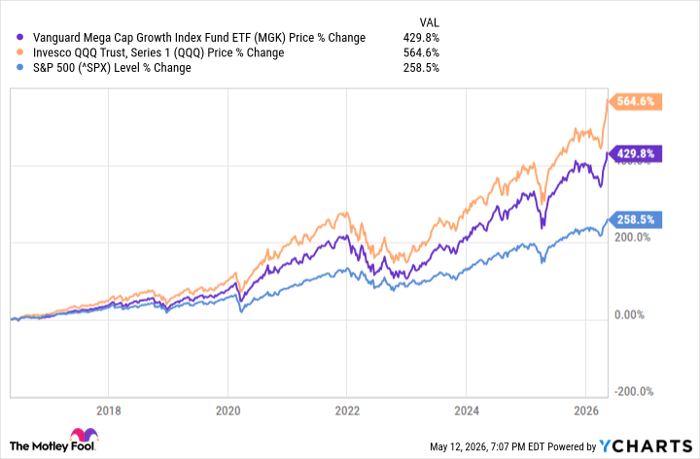
The Vanguard fund has gained 6.4% year to date as I write this (while QQQ has gained 15.1%), and for the past year it's gained 30% while QQQ is up 39%.
Like most Vanguard ETFs, the Vanguard Mega Cap Growth ETF charges low fees -- its expense ratio is only 0.05%. But the fund does not appear to be "cheap" if you look at its price-to-earnings (P/E) ratio of 39. That's higher than the QQQ fund's earnings multiple, which offers a price-to-earnings (P/E) ratio of around 34.
If you buy MGK instead of QQQ, you might pay too much for too little performance.
QQQ: Tried-and-true way to buy America's tech leaders
The Invesco QQQ ETF holds 102 stocks and has a total of $463 billion of assets under management. It charges an expense ratio of 0.18%, which is not as low as other funds, but is still highly competitive compared to many other ETFs.
This fund is almost as tech-heavy as the Vanguard Mega Cap Growth ETF. The Invesco QQQ ETF portfolio allocation is 64% to tech stocks. The fund's top five holdings as I write this are:
- Nvidia (8.8%)
- Alphabet (7.4%)
- Apple (7.1%)
- Microsoft (5.05%)
- Amazon (4.8%)
These top five stocks make up 33.2% of the fund. This makes the Invesco QQQ ETF a bit less top-heavy and more diversified than MGK.
MGK vs. QQQ: Which ETF should you buy?
If you want to take a concentrated position on tech stocks, just buying the Qs seems like a simpler choice. The Vanguard Mega Cap Growth ETF is constructed to be top-heavy with just a few stocks. It doesn't offer any additional diversification. The Vanguard fund's fees are a bit lower, but not enough to make up for long-term underperformance.
If you believe that the future of U.S. tech stocks is bright, buying the Invesco QQQ Trust could be a better choice than the Vanguard Mega Cap Growth ETF.
Should you buy stock in Invesco QQQ Trust right now?
Before you buy stock in Invesco QQQ Trust, consider this:
The Motley Fool Stock Advisor analyst team just identified what they believe are the 10 best stocks for investors to buy now… and Invesco QQQ Trust wasn’t one of them. The 10 stocks that made the cut could produce monster returns in the coming years.
Consider when Netflix made this list on December 17, 2004... if you invested $1,000 at the time of our recommendation, you’d have $469,293!* Or when Nvidia made this list on April 15, 2005... if you invested $1,000 at the time of our recommendation, you’d have $1,381,332!*
Now, it’s worth noting Stock Advisor’s total average return is 993% — a market-crushing outperformance compared to 207% for the S&P 500. Don't miss the latest top 10 list, available with Stock Advisor, and join an investing community built by individual investors for individual investors.
*Stock Advisor returns as of May 17, 2026.
Ben Gran has no position in any of the stocks mentioned. The Motley Fool has positions in and recommends Alphabet, Amazon, Apple, Microsoft, and Nvidia. The Motley Fool has a disclosure policy.
The views and opinions expressed herein are the views and opinions of the author and do not necessarily reflect those of Nasdaq, Inc.

