
Lithium Market Update: Q1 2026 in Review
Lithium prices have rebounded sharply, with spot battery-grade lithium carbonate rising from about US$13,433 per metric ton in early December to US$26,278 by late January, a 95 percent increase.
The rally reflects growing supply-side pressure, including delays at key operations such as CATL's (SZSE:300750,HKEX:3750) Jianxiawo lepidolite mine in China, ongoing maintenance at other facilities and increased competition for material tied to long-term contracts, according to information from Fastmarkets.
Market sentiment has also played a role, with speculative activity amplifying gains. However, underlying conditions remain uncertain. Thin spot liquidity and cautious positioning from both buyers and sellers point to a market vulnerable to sudden swings, where policy shifts or operational disruptions can quickly move prices.
Spodumene prices have followed suit, climbing above US$2,000 per metric ton for the first time since late 2023.
The move marks a significant shift for Australian producers, many of which scaled back or halted lithium operations when prices fell below US$900. Sustained strength at current levels could trigger a wave of restarts, improving margins and incentivizing supply. However, the pace of this response will be critical — while additional output from Australia and potentially Africa could ease near-term tightness, lead times may delay meaningful relief.
"Lithium prices appear to have moved ahead of the fundamentals, propelled by speculative buying, bullish sentiment and a backdrop of heightened geopolitical risk. Yet we may also be finally witnessing demand catch up with the supply surge of recent years," wrote Fastmarkets’ Paul Lusty in a January update.
"The key takeaway is to brace for more volatility — this is a market where a single headline, project delay or policy shift can rewrite the outlook overnight.”
Strong demand meets tightening supply
Lithium demand was robust in early 2026 due to electric vehicle (EV) and battery energy storage system gains.
Global EV sales rose 22 percent in 2025, noted Adam Webb, head of battery materials at Benchmark Mineral Intelligence, during a March summit in Toronto. He added that “despite what you may hear in some of the mainstream media,” EV sector gains were particularly strong in China, Europe and emerging markets.
Looking ahead, lithium-ion battery demand is forecast to rise at a 14 percent compound annual growth rate over the next decade, with lithium demand itself increasing by roughly 12 percent a year.
“To all intents and purposes, lithium is basically driven by battery demand only,” Webb said.
Lithium price rally signals structural shift
After a prolonged downturn, lithium prices rebounded sharply in late 2025 as market conditions tightened.
Lithium carbonate prices in Asia rose more than 90 percent from lows seen in October, while spodumene concentrate surged even further, reflecting upstream constraints.
“Prices increase because markets switch into deficit,” Webb said, pointing to a combination of factors behind the rally.
These include stronger-than-expected “first-use” demand from cathode and battery makers, supply disruptions in key producing regions and policy-driven demand pull-forward linked to changes in China’s VAT rebate on battery exports.
A key dynamic is the divergence between chemicals and raw materials.
While the broader lithium market may still show a modest surplus on paper, a structural deficit in spodumene, driven by converter overcapacity, has tightened upstream supply and strengthened pricing power for miners.
The rebound in prices has improved project economics, but a meaningful supply response is expected to lag.
During the prolonged market downturn, lithium project development activity fell sharply, with feasibility studies dropping from dozens annually to fewer than 10 in 2025.
During a SC Insights webinar held on March 31, founder Andy Leyland described October 2023 to October 2025 market dynamics as “unsustainable,” noting that prices fell well below levels needed to support new developments.
While current pricing has re-incentivized projects, many now require updated studies and fresh financing.
“It’s not even a decision that can be made today,” Leyland told listeners, pointing to delays of at least 12 months for many developments. Rising capital costs are adding further constraints, weakening returns even for lithium-focused projects with relatively low operating costs.
On the exploration side, budgets have decreased over the last two years in correlation to the depressed market.
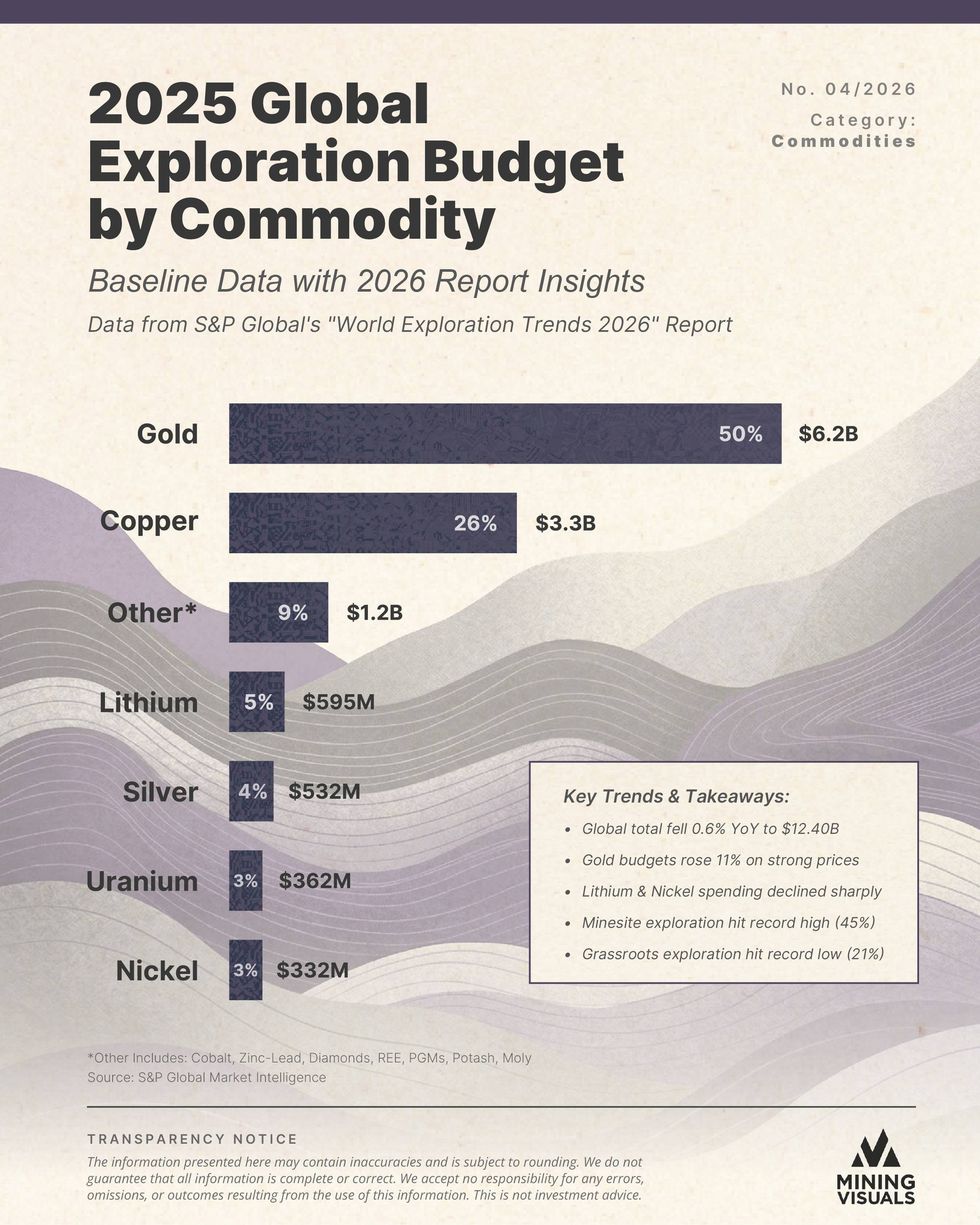
Infographic via Mining Visuals.
A graph shows 2025 global exploration budgets for various commodities.
As noted in the Mining Visuals infographic above, in 2025 global exploration expenditure for lithium ranked fourth at US$595 million, but was significantly lower than the top-ranked commodities, gold and copper.
Regional dynamics and strategic competition
In the near term, higher prices are more likely to unlock marginal supply rather than large-scale, low-cost projects.
Leyland said the market is increasingly incentivizing “fourth quartile” production — typically lower-grade material that can be brought online more quickly, but depends on sustained higher prices.
This includes supply from regions such as Africa, where growth is often accompanied by political, logistical and quality risks. As a result, while these sources can respond faster, they may also introduce greater volatility into the market.
Looking ahead, global supply growth remains uneven. South America continues to anchor long-term expansion, supported by improving policy environments in countries such as Argentina and Chile.
Australia is expected to deliver only modest near-term growth as previously shelved projects are reassessed.
China, the dominant consumer, faces constraints when it comes to domestic supply, and is increasingly focused on securing resources overseas. Leyland noted that Chinese players are prioritizing long-term supply security, in contrast to western markets that remain more focused on prices.
In Europe, early progress has been led by integrated projects combining extraction and processing.
“You saw Vulcan Energy Resources (ASX:VUL,OTCPL:VULNF) move forward … you saw [Sibanye-Stillwater's (NYSE:SBSW)] Keliber move forward,” Leyland said, adding that 2026 will be critical for refining projects, many of which face “make-or-break” conditions.
Companies are also shifting toward tolling models to reduce capital intensity.
- YouTube
Howard Klein, co-founder and partner at RK Equity, discusses the Trump administration's plans for Project Vault, as well as the broader lithium market.
Outlook: Elevated prices, persistent risks
Despite expectations of a nominal surplus in 2026, the lithium market appears structurally tight when viewed through upstream demand and supply constraints.
Zimbabwe’s decision to suspend exports of raw minerals and lithium concentrates on February 25 has added fresh pressure to an already tight market, accelerating a ban previously slated for 2027.
The move comes as the country seeks to boost domestic processing.
Zimbabwe is expected to produce about 124,000 metric tons of lithium carbonate equivalent in 2026, roughly 7 percent of global supply, and remains a key supplier to China, providing around 15 percent of its spodumene imports.
“Zimbabwe’s earlier-than-expected export ban on lithium concentrate has added further fuel to the bull case fire, with elevated spodumene prices likely to speed up the resumption of mining activities at mothballed Australian mines,” wrote Fastmarkets’ Lusty in a March report on the lithium industry.
Prices are expected to remain elevated in the near term, supported by delayed supply growth and strong demand.
At the same time, current pricing continues to support strong producer margins. Even higher-cost operations remain profitable, with some generating margins of around 50 percent, according to Benchmark’s Webb.
Looking further ahead, however, risks remain two sided. A sustained supply response could weigh on prices beyond 2026, while delays or disruptions could trigger renewed shortages.
As a result, the market outlook remains constructive, but increasingly volatile.
Don't forget to follow us @INN_Resource for real-time updates!
Securities Disclosure: I, Georgia Williams, hold no direct investment interest in any company mentioned in this article.
Editorial Disclosure: The Investing News Network does not guarantee the accuracy or thoroughness of the information reported in the interviews it conducts. The opinions expressed in these interviews do not reflect the opinions of the Investing News Network and do not constitute investment advice. All readers are encouraged to perform their own due diligence.
