
Key Points
D-Wave's products are already being utilized in the industry.
D-Wave is losing money, but it has plenty of cash to fund its operations for the next few years.
- 10 stocks we like better than D-Wave Quantum ›
While artificial intelligence (AI) is all the rage in the tech investing realm right now, quantum computing is the next emerging technology. Quantum computing could change what technologies are feasible, including some aspects of AI. If it can successfully be developed to commercial viability, this technology will take the world by storm, and investors will want to be positioned to take advantage of its growth years in advance of when it actually occurs, as the market will price huge anticipated growth into shares as that hoped-for success gets closer.
Indeed, many quantum computing stocks have already experienced huge run-ups, including D-Wave Quantum (NYSE: QBTS). Since the start of 2024, D-Wave's stock is up an incredible 1,460%. While that sounds like an impressive gain (and it is), at its peak last fall, D-Wave was up nearly 5,000%. This makes me wonder if the stock could return to that peak in the near future.
Will AI create the world's first trillionaire? Our team just released a report on the one little-known company, called an "Indispensable Monopoly" providing the critical technology Nvidia and Intel both need. Continue »
Is it too late to buy D-Wave Quantum's stock? Or is now a perfect time?
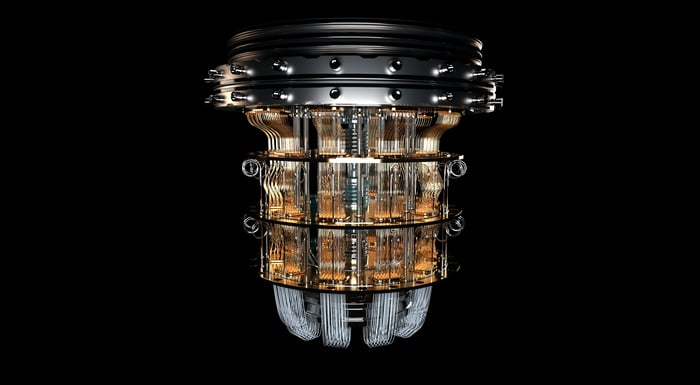
Image source: Getty Images.
D-Wave is taking a different approach to quantum computing
Most of the companies attempting to develop quantum computers are focused on relatively general-purpose machines. D-Wave Quantum isn't. It's working on a technology known as quantum annealing, which is designed to find the lowest or nearly the lowest energy states in a system. This makes it perfect for finding solutions for optimization problems like those that come up in logistic networks and AI inference. While the variety of tasks for which a quantum annealing system would be suitable is limited compared to what a general-purpose quantum computer would be useful for, D-Wave's technology could be applied to some of the areas where quantum computing is expected to be brought to bear first.
In fact, D-Wave has already used its systems to help multiple businesses optimize resources, build production schedules, and manage logistics. While these are fairly niche applications, they could be deployed in wider settings as the capabilities of the company's hardware improve.
D-Wave is one of the most practical ways to invest in quantum computing, as its products are aimed at practical applications. This makes me a long-term bull on D-Wave, but it still has a long way to go to become a viable company.
Right now, most of D-Wave's revenue comes from research partnerships and one-off early-stage product sales. In Q4, its top line totaled $2.7 million. However, its operating expenses totaled nearly $37 million -- it's burning through cash quickly. Fortunately, D-Wave has over $600 million in cash and equivalents on its books, so it can survive for a while at this loss rate.
D-Wave closed $12.4 million in bookings during Q4, up 471% from Q3's bookings. This shows that there is growing excitement about the company, but it's still not generating remotely enough business to break even. And with a market cap of around $5.5 billion, it trades at a lofty price-to-sales ratio of around 185. That's a lot of hoped-for future growth already priced into the stock.
I think D-Wave is an excellent long-shot investment. Still, investors should not invest more than they are willing to lose in it. It could become worthless just as easily as it could deliver incredible returns.
Should you buy stock in D-Wave Quantum right now?
Before you buy stock in D-Wave Quantum, consider this:
The Motley Fool Stock Advisor analyst team just identified what they believe are the 10 best stocks for investors to buy now… and D-Wave Quantum wasn’t one of them. The 10 stocks that made the cut could produce monster returns in the coming years.
Consider when Netflix made this list on December 17, 2004... if you invested $1,000 at the time of our recommendation, you’d have $533,522!* Or when Nvidia made this list on April 15, 2005... if you invested $1,000 at the time of our recommendation, you’d have $1,089,028!*
Now, it’s worth noting Stock Advisor’s total average return is 930% — a market-crushing outperformance compared to 185% for the S&P 500. Don't miss the latest top 10 list, available with Stock Advisor, and join an investing community built by individual investors for individual investors.
*Stock Advisor returns as of April 7, 2026.
Keithen Drury has no position in any of the stocks mentioned. The Motley Fool has no position in any of the stocks mentioned. The Motley Fool has a disclosure policy.
The views and opinions expressed herein are the views and opinions of the author and do not necessarily reflect those of Nasdaq, Inc.

